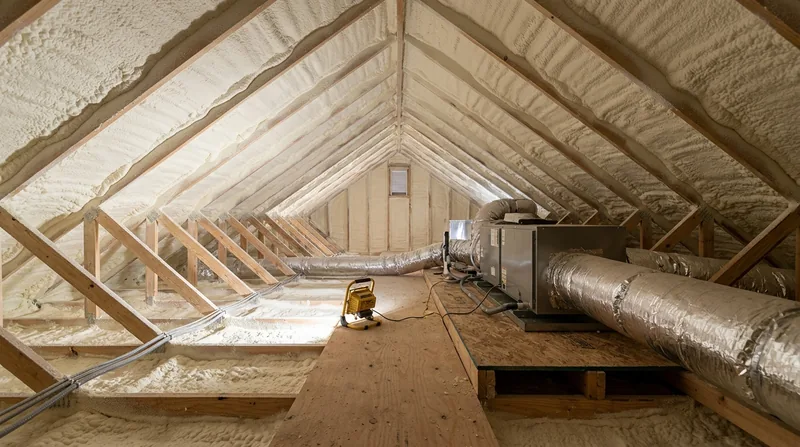




Jonesboro sits on Crowley's Ridge, a wooded rise surrounded by rice, soybean, and cotton fields that stretch to every horizon. Most homes here rest on vented crawl spaces raised on brick piers or concrete slabs, with air handlers and ductwork sitting in vented attics that bake at 130 to 150 degrees Fahrenheit through long, humid summers. Whether you own a 1910s frame cottage on the ridge, a 1950s brick ranch in Nettleton, or a newer two-story in Valley View or Brookland, that attic is your home's single largest thermal leak and moisture battleground. Attic spray foam insulation in Jonesboro seals and insulates that space in one pass, stops air leakage where fiberglass and cellulose fail, and creates a conditioned buffer that cuts cooling load and humidity infiltration year-round. We help homeowners and builders across Jonesboro, Bono, Brookland, Lake City, Caraway, and the surrounding Delta understand when spray foam is the right answer, how it works, and what to expect.
Why Attic Insulation Matters in Jonesboro's Heat and Humidity
An uninsulated or poorly insulated attic in Jonesboro is an open door to heat gain in summer and a moisture trap year-round. The Delta climate runs hot and humid for five months, and that attic temperature can exceed outdoor air by 30 to 40 degrees Fahrenheit. Fiberglass batts settle and leave gaps; blown-in cellulose compacts and loses R-value; and both allow air leakage around ducts, pipes, and electrical chases that no amount of batting depth will fix. Humidity from crawl spaces and outdoor air infiltrates through soffit vents, condenses on cool ductwork, and feeds mold growth and moisture damage. Spray foam insulation stops air movement entirely, maintains R-value over decades, and creates a sealed, conditioned attic that works with your HVAC system instead of against it.
- Eliminates air leakage around ducts, pipes, wiring, and attic penetrations that account for 15 to 30 percent of heating and cooling loss.
- Maintains consistent R-value without settling or moisture absorption over the life of the home.
- Reduces attic temperature by 15 to 25 degrees Fahrenheit on hot days, cutting air conditioning run time and peak demand.
- Prevents humid outdoor air from entering the attic through soffit vents and condensing on cool ductwork and structural framing.
- Protects wood framing from moisture damage and the wood-rot fungi and termite damage that thrive in warm, damp attics on the Ridge.
These benefits stack fast in a climate where summer cooling and humidity control drive every insulation decision. See our closed cell spray foam insulation page for the technical R-value and durability specs that justify the investment in a sealed attic.
Key info: Jonesboro building code and the local building official govern attic ventilation, ignition barriers, and thermal barrier requirements at your address. A vented attic with soffit and ridge vents is one approach; a sealed attic with closed-cell foam and no ventilation is another. Both are code-compliant when done correctly. Your permit application and our estimate will confirm which path your home requires and what thickness and R-value the code calls for at your location.
How Attic Spray Foam Insulation Works: Jonesboro Installation Steps
Spray foam installation in an attic is a controlled, step-by-step process that starts with site assessment and ends with a fully sealed, insulated space ready for occupancy. We begin with a walk-through to measure the attic floor, identify air leaks, assess any existing insulation and moisture, and verify that the substrate is sound and dry. We then remove old insulation if needed, seal large gaps and penetrations, and prepare the space for foam application. Once you understand the process and approve the estimate with R-value and thickness specifications, we spray the foam in thin, even passes, allowing proper cure time between passes and mechanical ventilation throughout the job. The foam expands, hardens, and creates an air-tight, insulating shell that bonds to the roof deck, joists, and framing.
- We visit your home, measure the attic floor square footage, and identify air leaks, existing insulation type, and any moisture or damage.
- We provide a written estimate with R-value, foam thickness, and the code requirements that apply to your address in Jonesboro.
- We schedule the work and prepare the attic by removing old insulation if required and sealing large holes or penetrations.
- We spray closed-cell or open-cell foam in thin passes, controlling thickness and ratio, with mechanical ventilation running during and after application.
- We allow the foam to cure fully before re-entry, typically 24 to 48 hours depending on ambient temperature and humidity.
- We inspect the finished work, verify coverage and thickness, and walk you through the final result and warranty terms.
A typical 1,500-square-foot attic in a Jonesboro brick ranch takes two to three days from start to finish, including removal of old insulation and cure time. The process is cleaner and faster than blown-in alternatives, and the result is a permanently sealed, air-tight space.
Example: A homeowner in Nettleton with a 1950s brick ranch and a flat, compacted attic full of old fiberglass called for a quote. We removed the failing insulation, sprayed 5.5 inches of closed-cell foam to achieve R-38, sealed the roof deck and all penetrations, and cut the homeowner's summer cooling load by an estimated 20 to 25 percent. The sealed attic also stopped humidity infiltration and protected the wood framing from the moisture damage common in older Jonesboro homes.
| Approach | Description | Best for |
|---|---|---|
| Closed-Cell Spray Foam | High-density foam with R-6.5 per inch, water-resistant, air-tight seal, durable over decades. | Attics in hot, humid climates where air sealing and moisture control are priorities; sealed roof decks; humid crawl spaces. |
| Open-Cell Spray Foam | Lower-density foam with R-3.6 per inch, sound-dampening, air-tight, lower cost, allows some vapor transmission. | Attics where sound control is valued and humidity is managed by separate means; budget-conscious retrofits; vented attics. |
| Foam Over Existing Insulation | Spray 2 to 3 inches of open-cell or closed-cell foam over sound, dry existing insulation to boost R-value and seal air leaks. | Top-up jobs where old insulation is in good condition and the goal is sealing air leaks and adding R-value without full removal. |
| Full Removal and Spray | Remove all old insulation, clean the attic, spray new foam to the required R-value and thickness in one system. | Failed insulation, moisture damage, mold history, or when a new sealed attic is the goal and code permits it. |
Attic Spray Foam Insulation Cost in Jonesboro: What to Expect
Attic spray foam insulation in Jonesboro typically runs from $1.50 to $2.50 per square foot of attic floor, depending on foam type, required R-value, the cost to remove old insulation, and site access. A 1,500-square-foot attic with closed-cell foam to R-38 and full insulation removal usually falls in the $2,250 to $3,750 range. Open-cell foam costs less per square foot but requires more thickness to reach the same R-value, so the final price difference is often smaller than expected. A top-up job, where you spray 2 to 3 inches of foam over existing sound insulation, costs less because no removal is required.
The largest cost variables are insulation removal (if the old material is wet, moldy, or contaminated), attic floor area and geometry (complex rooflines and many penetrations take longer), and the R-value your code and climate demand. A 1,200-square-foot attic in Brookland with simple geometry and no removal might run $1,800 to $2,200. A 2,000-square-foot two-story in Valley View with a complex roof and full insulation removal could reach $4,000 to $5,500. We provide a written estimate with R-value, thickness, and all cost drivers spelled out before any work starts. See our pricing page for more detail on what moves the cost up and down.
Getting 2 to 3 estimates from local contractors is smart practice. Look for estimates that specify R-value, foam thickness in inches, and what is included (removal, labor, materials, cleanup). Avoid any quote that leaves those details blank or promises a price far below market without a clear scope. The cheapest estimate is rarely the best value when the difference is $1,000 or more.
What to Look for When Hiring an Attic Spray Foam Insulation Contractor Near Jonesboro
Choosing a spray foam contractor is a decision that affects your home's comfort, energy use, and resale value for decades. The trade has its share of rig-and-run outfits (out-of-state crews, a job sprayed in an afternoon, nobody reachable when the smell will not go away) and national franchises with mixed local accountability. A local independent contractor with a local address, local crews, and a track record in Jonesboro is your best bet. Start by asking any contractor you interview for a written estimate with R-value and thickness specs, proof of full insurance, and references from homes in your area. Call those references and ask about the installer's communication, the job timeline, cure time and re-entry, and whether any issues came up after the work was done.
Verify that the contractor understands the building code and permitting requirements that apply at your address. Attic ventilation, ignition barriers, and thermal barrier rules vary by city and building official across Greater Jonesboro, and there is no reciprocity between jurisdictions. A good contractor will tell you what your local code requires and help you navigate the permit process. Ask whether the work requires a permit in your city (it often does) and whether the contractor pulls permits or helps you do so. Check the contractor's insurance certificate to confirm full coverage and that the policy is current. Never hire a contractor who claims to be licensed or bonded without verifying the claim with the appropriate state or city agency, and never accept vague assurances about credentials.
Finally, trust your instincts about communication and professionalism. A contractor who listens to your concerns, answers your questions directly, and provides a clear timeline and warranty is more likely to deliver a good result than one who rushes the estimate or avoids details. Call us at (870) 641-6546 for a free, no-obligation estimate, or request an estimate online. We respond within 24 hours and are happy to answer questions about our process, insurance, and how we handle the specifics of your attic and your local code.
Attic Spray Foam Insulation in Jonesboro: Pricing Guide
| Service | Price | Details |
|---|---|---|
| Open-Cell Spray Foam Attic Top-Up | Starting at $1.50/sq ft | 2 to 3 inches of open-cell foam over existing sound insulation to seal air leaks and boost R-value without removal |
| Closed-Cell Spray Foam Full Attic Install | Starting at $2.00/sq ft | Complete sealed attic with insulation removal, closed-cell foam to R-38 or R-49, all labor and materials included |
| Open-Cell Full Attic Install | Starting at $1.75/sq ft | Full removal and open-cell foam spray to code-required R-value, lower cost than closed-cell, best for dry climates |
| Complex or Large Attic Project | On estimate | Attics over 2,000 square feet, complex rooflines, moisture damage, or special code requirements need site assessment before quote |
| Travel and Estimate | Free | No charge for travel within Jonesboro and surrounding areas; free written estimate with R-value and thickness specs; response within 24 hours |
Indicative pricing, the exact cost depends on square footage, finish, and site access. Free personalized estimate within 24h at (870) 641-6546.


