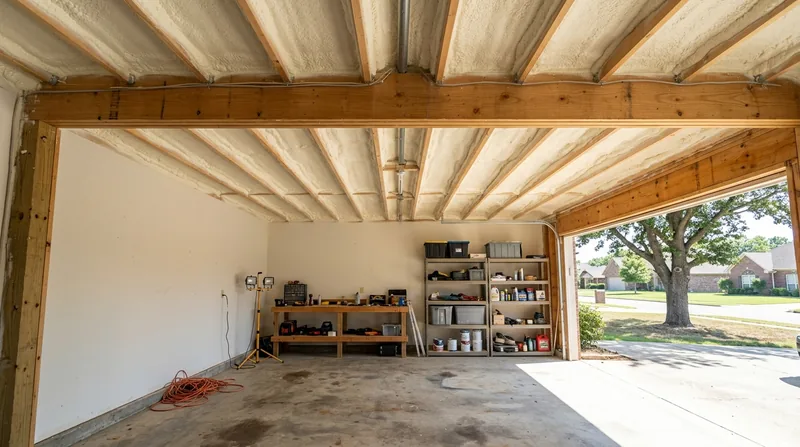




Jonesboro's garages face a unique climate challenge. Built onto the ridge above the Delta, most homes here sit under long, punishing summers with heat and humidity that turn an uninsulated garage into a radiant oven by July, then shift to damp cold in winter when ice storms roll through. Whether your garage is attached to a brick ranch built in the 1970s, a newer two-story with a bonus room overhead, or a detached farm shop, garage spray foam insulation in Jonesboro stops the temperature swing, controls condensation on metal studs and equipment, and makes the space usable year-round. We spray closed-cell and open-cell foam into garage ceilings, walls, and band joists to seal the envelope, then help you navigate local building code and permitting. Since 2012, we have insulated garages across Jonesboro, Bono, Brookland, and the surrounding ridge communities. Read on to understand why garage insulation matters here, how the work gets done, and what to expect on cost.
Why Garage Spray Foam Insulation Matters on Crowley's Ridge
A garage in Jonesboro sits exposed to extremes. Summer heat radiates through an uninsulated ceiling and walls, turning the space into a furnace where paint thins, batteries die, and rubber seals crack. Winter brings humidity and condensation that pools on concrete, rusts tools, and feeds mold on drywall. Attached garages leak unconditioned air into living spaces, forcing your HVAC to work harder. Spray foam stops all three: it creates an air barrier, it controls moisture by blocking the movement of humid air, and it holds temperature steady. A garage insulated with closed-cell foam stays 15 to 20 degrees cooler in summer and holds heat in winter. For farm shops and equipment storage across the Delta, closed-cell foam prevents the heavy condensation that collects on steel when warm, humid air meets cold metal.
- Spray foam seals air leaks that fiberglass batts cannot reach, eliminating drafts and reducing HVAC runtime.
- Closed-cell foam carries an R-value of 6.5 to 7 per inch, delivering insulation and air sealing in a single step.
- The foam cures rigid and does not settle or sag over time, unlike blown-in fiberglass that compacts after five years.
- Garage ceilings and walls stay dry because foam blocks the air movement that carries moisture into cavities.
- Attached garages sealed with foam reduce heat loss through shared walls and rim joists, lowering whole-house heating and cooling load.
A sealed, insulated garage becomes storage space that protects equipment and vehicles instead of destroying them.
Local example: A 1970s brick ranch in south Jonesboro with a 400-square-foot attached garage and an uninsulated ceiling experienced condensation pooling on the concrete every winter and summer temperatures exceeding 110 degrees. After we sprayed 2 inches of closed-cell foam on the ceiling and sealed the rim joist, the garage stayed dry and remained 18 degrees cooler in July. The homeowner also noticed the kitchen above the garage no longer felt drafty in winter.
How We Insulate Your Garage: The Process in Jonesboro
Garage spray foam insulation starts with a walk-through. We measure the ceiling, check wall cavities, identify rim joists and band joists that need sealing, and assess whether the space is attached or detached. We look at the substrate, moisture condition, and existing insulation. We ask whether you want the garage conditioned (as part of your living envelope) or semi-conditioned (blocked from the house but protected from weather). That choice drives whether we foam the shared wall with the house or just the ceiling and exterior walls. We then provide a written estimate with R-value, thickness, and square footage so you know exactly what you are paying for. Once approved, we schedule the work, set up ventilation, spray the foam to specification, allow proper cure time, and leave the space ready for use within 24 to 48 hours.
- We perform a site walk-through and measure all surfaces to be insulated, including ceiling, walls, rim joists, and band joists.
- We identify the substrate condition and any existing insulation, fiberglass, or debris that must be removed or worked around.
- We recommend closed-cell foam for garages in Jonesboro because it provides air sealing, moisture control, and high R-value in tight spaces.
- We spray foam to the thickness and R-value specified in the estimate, using proper drum temperature, hose setup, and spray technique.
- We set up mechanical ventilation during cure and establish a re-entry window so you know when the space is safe to use.
- We discuss local building code requirements with you and help you understand what permits or inspections your city may require.
The result is a garage that stays dry, holds temperature, and protects everything inside it. For more detail on how we handle other insulation projects across your home, see our attic spray foam insulation page.
Jonesboro example: A detached 600-square-foot farm shop in Brookland with metal stud walls and an uninsulated metal roof was collecting condensation so heavy that tools rusted in place. We removed old fiberglass batts from the walls, sprayed 2.5 inches of closed-cell foam on the ceiling and upper walls, and sealed all rim and band joists. The condensation stopped immediately. The shop stayed 25 degrees cooler in summer and remained usable year-round.
| Approach | Description | Best for |
|---|---|---|
| Closed-cell foam, 2-3 inches | High-density spray foam that cures rigid, delivers 6.5-7 R-value per inch, and acts as air barrier and vapor retarder in one pass. | Attached garages, farm shops, metal buildings, and any space where condensation control and high R-value are priorities. |
| Open-cell foam, 4-6 inches | Lower-density foam that cures soft, provides good insulation and sound dampening, and allows drying if moisture enters the cavity. | Detached garages or hobby spaces where budget is a priority and condensation risk is lower. |
| Ceiling only with rim joist sealing | Spray foam applied to the ceiling and rim joists to block air leakage and reduce HVAC load, leaving walls uninsulated. | Attached garages where the goal is to reduce heat loss to living spaces and stop drafts from the foundation rim. |
| Full envelope (ceiling, walls, rim joist) | Spray foam applied to all exposed surfaces to create a fully conditioned or semi-conditioned garage space. | Detached garages, farm shops, bonus rooms over garages, and any space intended for regular use or equipment storage. |
Garage Spray Foam Insulation Cost in Jonesboro: What to Expect
Garage spray foam insulation in Jonesboro typically starts at $1,200 for a small, single-car garage with a basic ceiling spray. The final cost depends on the size of the garage, the surfaces you want insulated (ceiling only, walls, or full envelope), the thickness of foam, whether you need insulation removal first, and the condition of the substrate. A 400-square-foot attached garage with a 2-inch closed-cell foam ceiling and rim joist sealing will run higher than a 200-square-foot detached garage with open-cell foam on the ceiling only. Access and substrate preparation also matter. If we must remove old fiberglass, debris, or damaged drywall before spraying, that work adds cost. If the garage has moisture or a wet crawl space below, we fix the moisture first or we walk away, and remediation costs money upfront but prevents foam failure later. We provide a written estimate with R-value, thickness, and square footage so you see exactly what you are paying for and why. For detailed pricing across all our services, visit our pricing page. The best approach is to get 2 or 3 estimates from local contractors so you can compare not just price but scope, warranty, and insurance coverage.
Garage Spray Foam Insulation Near Me: What to Look for When Hiring a Contractor in Jonesboro
Hiring the right spray foam contractor is as important as the product itself. The insulation trade includes both local shops and national franchises, and both rig-and-run crews that spray a job in an afternoon and disappear. The difference is accountability, local knowledge, and honest guidance. When you contact a contractor, ask for a written estimate that includes R-value, thickness, and square footage. Verify that the contractor is fully insured and ask to see the certificate. Check references and ask previous customers about the quality of the work, how the crew handled cleanup, and whether any smell or off-gassing issues arose after installation. Understand what permits your city requires. Jonesboro, Bono, Brookland, and other municipalities in the area have different building codes and permitting rules, and a good contractor will help you navigate what applies at your address. Ask about the cure time and re-entry window, and do not accept promises of same-day re-entry. Proper cure takes 24 to 48 hours, and a contractor promising otherwise is cutting corners. Finally, get multiple estimates. Price alone does not tell you what you are getting, and the lowest bid often reflects cutting corners on material, technique, or insurance. For a free estimate and to discuss your garage insulation needs, contact us at (870) 641-6546.
Garage Spray Foam Insulation in Jonesboro: Pricing Guide
| Service | Price | Details |
|---|---|---|
| Small attached garage, ceiling only | Starting at $1,200 | 2 inches closed-cell foam on ceiling and rim joist sealing for a single-car garage, typical 200-300 sq ft |
| Medium attached garage, full envelope | Starting at $2,400 | 2-3 inches closed-cell foam on ceiling, walls, and rim joists for a 400-500 sq ft two-car garage, includes air sealing |
| Detached garage or farm shop with open-cell foam | Starting at $1,600 | 4-6 inches open-cell foam on ceiling and walls, 300-400 sq ft, lower cost alternative with good insulation value |
| Insulation removal and replacement | On estimate | Cost varies by volume of old insulation, substrate condition, and disposal requirements; assessed on site |
| Travel and estimate | Included / Free | No mileage fee within Jonesboro and surrounding areas; free estimate with response within 24 hours |
Indicative pricing, the exact cost depends on square footage, finish, and site access. Free personalized estimate within 24h at (870) 641-6546.


