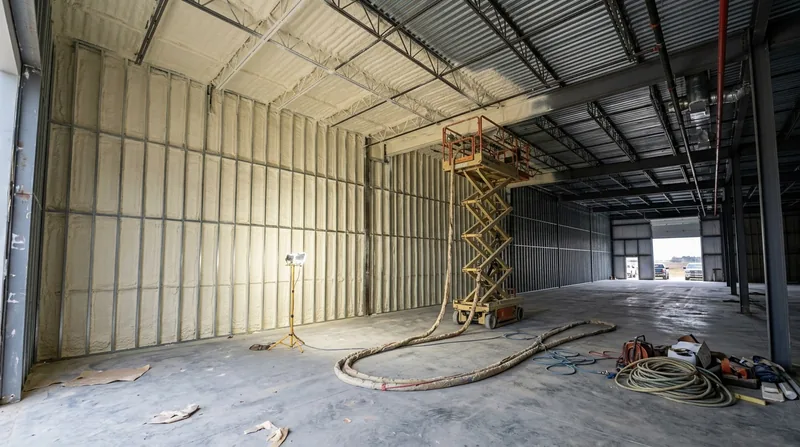




Commercial and new construction spray foam insulation in Jonesboro is built for the specific challenge of the Delta: industrial parks and farm equipment sheds that sweat condensation year-round, new construction shells on Crowley's Ridge that need a tight thermal envelope before the Arkansas humidity finds its way in, and metal buildings across Craighead and Poinsett counties where steel surfaces and moisture are a permanent partnership. When a new commercial structure goes up in Jonesboro or a farm operation adds a grain shed in Mississippi County, the insulation choice matters from the first day of operation. We spray closed-cell and open-cell foam into walls, roof decks, rim boards, and structural cavities, seal the air leaks that undermine every other effort, and leave you with a building envelope that holds temperature and keeps moisture out. Whether it is a new build or a retrofit of an older industrial space, spray foam insulation for commercial and new construction is the fastest, most complete way to get there. Call us at (870) 641-6546 for a free commercial estimate, or learn more about our closed-cell spray foam insulation and how it handles the condensation that kills uninsulated metal buildings.
Why Commercial and New Construction Spray Foam Matters on Crowley's Ridge and the Delta
The industrial footprint around Jonesboro runs grain storage, equipment repair shops, and metal-frame farm buildings scattered across rice and soybean fields. A standard fiberglass or blown-in insulation does not stop the moisture that condenses on cold steel in summer or the air leaks that let heated or cooled air escape through every seam. New commercial construction, whether it is an industrial park building or a barndominium on the edge of town, starts with the envelope. Spray foam fills cavities completely, adheres to steel and concrete, and does not settle or compress over time the way loose-fill does.
- Closed-cell foam resists moisture infiltration and provides structural bracing for metal and wood framing.
- Open-cell foam offers cost-effective coverage for interior walls and non-critical cavities where vapor permeability is acceptable.
- Spray foam seals around electrical, mechanical, and structural penetrations that hand-fitting cannot reach.
- The finished foam creates an air-tight thermal boundary that reduces HVAC load and keeps condensation off metal surfaces.
A properly insulated commercial shell in Jonesboro holds temperature and stays dry, which means lower operating cost and longer equipment life.
Key info: The 2020 tornado that damaged the Turtle Creek commercial area left many older industrial buildings exposed. New construction and rebuilds in that zone now require envelope performance that stops air infiltration and manages moisture. Spray foam is the fastest way to achieve code compliance and operational durability.
For more detail on how closed-cell foam handles the specific moisture challenge of metal buildings, see our metal building and barndominium spray foam service.
How We Spray Commercial and New Construction Buildings in Jonesboro
On a new commercial project, the foam goes in before drywall, roofing, and finish work. On a retrofit, we work inside the existing envelope or on exposed cavities. The process is the same: we assess the substrate (concrete, steel, wood, or masonry), verify it is clean and dry, and spray the foam at the manufacturer's specified thickness and ratio. Mechanical ventilation runs during the cure period, and we establish a re-entry window of 24 to 48 hours before the space is occupied or sealed.
- We inspect the space and identify all cavities, penetrations, and surfaces to be sprayed.
- We verify substrate condition and perform any necessary cleaning or repair.
- We set up ventilation, containment, and safety measures per the foam manufacturer's protocol.
- We spray foam at the specified thickness and density, working systematically from bottom to top.
- We allow the foam to cure under mechanical ventilation for the full recommended period.
- We trim excess foam flush with the substrate and mark the R-value and thickness on the job card.
The result is a sealed, insulated envelope with documented R-value and no air leaks at joints or penetrations.
Example: A new equipment storage building in Monette needed closed-cell foam in the walls and roof deck to prevent condensation on metal components. We sprayed 2 inches of closed-cell, sealed every penetration, and documented the 13.5 R-value per inch. The building stayed dry and the equipment lasted longer.
See our air sealing service for detail on how we handle penetrations and transitions in commercial work.
Commercial and New Construction Spray Foam Methods and Materials
| Approach | Description | Best for |
|---|---|---|
| Closed-Cell Spray Foam | High-density foam with closed cell structure; R-value 6.0 to 7.0 per inch; vapor-impermeable; provides structural support. | Metal buildings, roof decks, rim boards, and cavities where moisture control and structural bracing are priorities. |
| Open-Cell Spray Foam | Lower-density foam with open cell structure; R-value 3.5 to 3.8 per inch; vapor-permeable; lighter and less expensive. | Interior walls, non-structural cavities, and new construction where cost and vapor permeability matter more than moisture resistance. |
| Injection Foam (Closed-Cell) | Low-pressure closed-cell foam injected into existing wall cavities; fills without disturbing finishes; R-value 3.5 to 4.0 per inch. | Retrofit of existing commercial walls where spray access is limited or interior finishes must remain undisturbed. |
| Rim and Band Joist Sealing | Closed-cell foam sprayed into the cavity between the rim board and foundation; seals air leaks and provides thermal break. | New construction on concrete slabs or piers; prevents air infiltration at the foundation-to-wall transition. |
Commercial and New Construction Spray Foam Cost in Jonesboro: What to Expect
The cost of spray foam for a commercial or new construction project depends on the size of the space, the type of foam, the thickness required by code, and the complexity of the surfaces to be sprayed. A 5,000-square-foot industrial building shell will cost more than a 1,000-square-foot equipment shed, and a retrofit with difficult access costs more than new construction where the space is open. We provide a free commercial estimate on site, where we measure the cavities, note the substrate, and specify the foam type and thickness that meets your building code and use case.
Typical commercial projects run from a few thousand dollars for a small outbuilding to $15,000 to $30,000 or more for a larger industrial or new construction shell, depending on total square footage and foam selection. The estimate includes a detailed breakdown of the scope, the R-value and thickness per section, the labor, and any air sealing around penetrations. Call us at (870) 641-6546 to request a free estimate and learn what your specific project will cost. For a full pricing overview and our standard service rates, visit our pricing page.
What to Look for When Hiring a Spray Foam Contractor Near Jonesboro
When you are selecting a spray foam insulation contractor for a commercial or new construction project, verify that the contractor is fully insured and can provide a certificate of insurance on request. Ask for written estimates that specify the R-value and thickness of the foam, the type (closed-cell or open-cell), and the total square footage and board footage to be sprayed. Check references from recent commercial projects in the area, and ask how the contractor handles permitting and code compliance at your specific address. The local building department in Jonesboro, Bono, Brookland, or any other city where your project sits will have specific requirements for thermal barriers, ignition barriers, and ventilation, and any contractor worth hiring will know them and defer to the official in charge.
- Get written estimates from at least two contractors that include R-value, thickness, foam type, and total cost.
- Verify that the contractor is fully insured and ask to see the certificate of insurance.
- Ask how the contractor ensures proper ratio, drum temperature, and mechanical ventilation during cure.
- Check that the contractor documents the re-entry window (typically 24 to 48 hours) and communicates it clearly to you and your occupants.
- Confirm that the contractor understands the local building code and permitting process for your city and address.
- Ask for references from commercial or new construction projects completed in the past two years.
An estimate with no R-value and thickness, no ventilation plan, or a price far below market is a signal to move on. For a free estimate on your commercial or new construction project, contact us at (870) 641-6546. We respond within 24 hours and will walk you through the scope, the code requirements at your address, and the cost.
Commercial & New Construction Spray Foam in Jonesboro: Pricing Guide
| Service | Price | Details |
|---|---|---|
| Commercial Estimate | Free | On-site measurement, foam type and thickness specification, R-value documentation, no obligation to book |
| Small Commercial Building (under 2,000 sq ft) | Starting at $3,500 | Closed-cell or open-cell foam, rim joist sealing, basic air sealing, includes labor and materials |
| Medium Commercial or New Construction (2,000 to 5,000 sq ft) | Starting at $8,000 | Full wall and roof deck coverage, closed-cell for moisture control, penetration sealing, complete thermal envelope |
| Large Industrial or Complex Project (5,000+ sq ft) | On estimate | Requires on-site inspection, substrate assessment, and detailed scope before pricing; typically $15,000 to $40,000+ |
| Travel | Included | No mileage fee or separate travel charge within Jonesboro and surrounding service area cities |
| Estimate Response | 24 hours | Call (870) 641-6546 to schedule; free, no-obligation estimate with detailed written breakdown |
Indicative pricing, the exact cost depends on square footage, finish, and site access. Free personalized estimate within 24h at (870) 641-6546.


