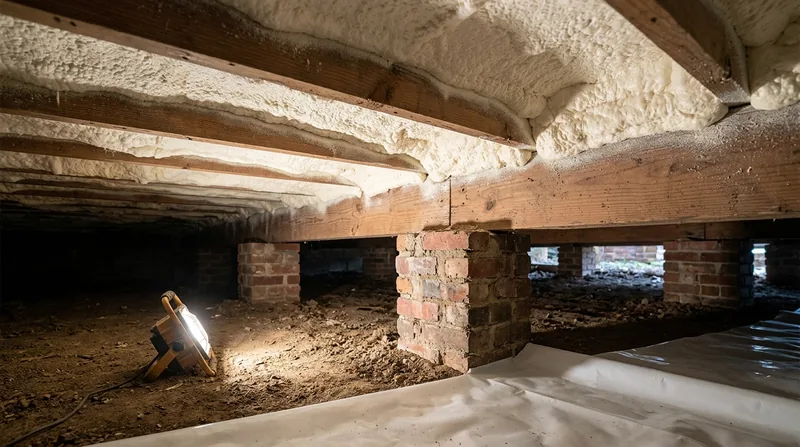




Crawl spaces beneath Jonesboro homes sit on brick piers or concrete blocks, raised above the Delta clay and subject to the region's relentless humidity and moisture vapor pressure. The vented crawl space, standard in the 1950s through 1980s brick ranches that dominate the city, draws humid air through foundation vents, cooling ductwork and supply lines that sit exposed in that damp cavity. Crawl space spray foam insulation seals the rim band, band joist, and foundation walls with closed-cell foam, stopping the moisture load before it enters the conditioned space and protecting the structure from the wood rot and mold pressure that define the Jonesboro climate. This is not cosmetic work. It is the foundation of comfort, air quality, and structural longevity in a home built on Crowley's Ridge. Learn more about how closed-cell spray foam insulation controls moisture in this environment.
Why Crawl Space Insulation Matters in Jonesboro: Moisture and Energy Loss
Jonesboro sits on a ridge surrounded by rice and soybean fields that flood seasonally, creating a moisture-saturated air mass that persists through the long humid summers. A vented crawl space draws that moisture continuously, cooling the supply ductwork and raising the load on the air handler running twelve to sixteen hours a day. The result is higher energy bills, condensation on ductwork, rust on metal fasteners, and wood decay that spreads silently into rim joists and band beams. Closed-cell spray foam seals the foundation perimeter and stops the moisture infiltration at the source.
- We seal rim joists and band joists with closed-cell foam to block humid air from entering the crawl space cavity.
- We insulate foundation walls and the rim band to create a continuous thermal and moisture barrier.
- We protect exposed ductwork and supply lines from condensation and corrosion.
- We restore the structural integrity of wood members by eliminating the wet-dry cycles that cause rot.
The payoff is a dry crawl space, stable ductwork performance, and a home that stays comfortable without overworking the air handler.
Key info: A 1,500 square foot brick ranch in Jonesboro with a vented crawl space typically loses 20 to 40 percent of conditioned air through leaks in the rim band and supply ductwork. Sealing that perimeter with spray foam reduces the load on the air handler and cuts moisture infiltration to near zero.
For more on how air sealing complements insulation, see our air sealing service page.
How We Insulate Crawl Spaces in Jonesboro: The Process
Crawl space spray foam work begins with a walk-through inspection to assess the foundation condition, identify moisture sources, and check for existing insulation or fiberglass batts that need removal. We measure the linear footage of rim band and band joist, the perimeter of the foundation wall, and the height of the cavity. We then quote a closed-cell foam system, specify the thickness in inches and the R-value per inch, and confirm that mechanical ventilation will run during the cure window to manage off-gassing. The job follows a strict sequence: prep and protection, foam application in controlled passes, and a re-entry window of twenty-four to forty-eight hours before normal occupancy.
- We inspect the crawl space and document the rim band, band joist, and foundation wall condition before any estimate is given.
- We remove old fiberglass batts, debris, or failed insulation if the scope includes insulation replacement.
- We set up mechanical ventilation to run during the cure cycle and ensure air circulation until the foam is fully set.
- We apply closed-cell foam in multiple thin passes to achieve the specified thickness and R-value without over-application.
- We provide a written estimate with R-value and thickness specifications before any work begins.
The entire process takes one to two days depending on the perimeter and access. Once cured, the foam hardens into a rigid, moisture-proof seal that protects the rim band and foundation for decades.
Example: A 1980s brick ranch in Brookland with a 40-foot perimeter, 18 inches of rim band height, and original fiberglass batts removed typically receives 2.5 inches of closed-cell foam (R-18 to R-20) applied in two passes, with mechanical ventilation running for 48 hours. Total time on site is 8 to 12 hours spread across two days.
If your crawl space also needs insulation removal, we handle that as part of the prep phase.
Crawl Space Spray Foam Methods and Approaches
| Approach | Description | Best For |
|---|---|---|
| Closed-Cell Rim and Band Joist Seal | 2 to 3 inches of closed-cell foam applied to the rim band, band joist, and top plate of the foundation wall, creating a continuous air and moisture seal. | Jonesboro homes with vented crawl spaces, existing moisture problems, or ductwork in the cavity that needs protection. |
| Foundation Wall Insulation | Full-height closed-cell foam application to the interior face of the foundation wall, creating an insulated and sealed crawl space perimeter. | Retrofits of 1950s-1980s brick homes where moisture and heat loss are chronic, and the crawl space will remain vented or transitional. |
| Insulation Removal and Replacement | Removal of old fiberglass batts or failed foam, disposal, and application of new closed-cell foam to the rim band and foundation wall in a single job. | Homes with deteriorated insulation, moisture damage, or previous spray foam work that failed or was installed without proper ventilation. |
| Ductwork and Supply Line Protection | Spot application of closed-cell foam around exposed supply ducts, return lines, and condensation-prone areas in the crawl space cavity. | Homes where ductwork sits in the crawl space and condensation, corrosion, or mold growth is occurring on metal or fiberglass. |
Crawl Space Spray Foam Insulation Cost in Jonesboro: What to Expect
Crawl space spray foam insulation in Jonesboro starts at around $2,500 for a basic rim band and band joist seal on a small ranch with limited perimeter and good access. The price moves up based on the linear footage of rim band to be sealed, the height of the cavity, whether existing insulation must be removed, and the thickness of foam specified (typically 2 to 3 inches of closed-cell). A full foundation wall insulation on a larger home or one with a longer perimeter will run higher. Access difficulty, moisture remediation, or the need for extensive prep work will also affect the final cost.
We provide written estimates with R-value and thickness specifications so you know exactly what you are paying for and why. Comparing two or three estimates from different contractors is always smart. Look for estimates that name the foam type, specify the thickness in inches, state the R-value, and confirm that mechanical ventilation will run during cure. A price far below market with no details is a red flag.
For a full pricing overview and to request a free estimate, visit our pricing page or call (870) 641-6546 for a same-day response.
Crawl Space Spray Foam Insulation Near Me: What to Look for When Hiring a Contractor
Hiring the right spray foam contractor is critical because poor installation, inadequate ventilation during cure, or the wrong foam type for your crawl space will create problems that are expensive to fix. The contractor should provide a written estimate with R-value and thickness specs, explain why closed-cell foam is the right choice for your foundation, and confirm that mechanical ventilation will run during the cure window. Ask for references from recent jobs in Jonesboro or Brookland, and verify that the contractor is fully insured with a certificate of insurance available on request.
Check whether the contractor pulls permits if your city requires them. Permitting rules vary across Greater Jonesboro, so ask your local building department what applies at your address. If you live in an HOA community or a historic district, confirm that exterior foundation work does not require architectural approval. Ask how the contractor will handle any moisture or standing water in the crawl space before foam is applied. A reputable contractor will say plainly that the substrate must be dry or the job does not proceed.
Call us at (870) 641-6546 or visit our contact page to request a free estimate and ask any questions about how we work and what to expect.
Crawl Space Spray Foam Insulation in Jonesboro: Pricing Guide
| Service | Price | Details |
|---|---|---|
| Rim Band and Band Joist Seal | Starting at $2,500 | Closed-cell foam applied to rim band and band joist perimeter, typically 2 to 2.5 inches, includes removal of old batts |
| Foundation Wall Insulation | Starting at $4,200 | Full-height closed-cell foam on interior foundation wall face, R-18 to R-20, perimeter and access determine final cost |
| Complete Crawl Space Encapsulation with Foam | Starting at $6,500 | Rim band, band joist, and full foundation wall insulation with closed-cell foam, includes old insulation removal |
| Ductwork and Supply Line Protection | Starting at $1,200 | Spot application of closed-cell foam around exposed ducts and condensation-prone areas, minimal perimeter work |
| Estimate and Site Visit | Free | Written estimate with R-value and thickness specs, response within 24 hours at (870) 641-6546, no obligation |
Indicative pricing, the exact cost depends on square footage, finish, and site access. Free personalized estimate within 24h at (870) 641-6546.


