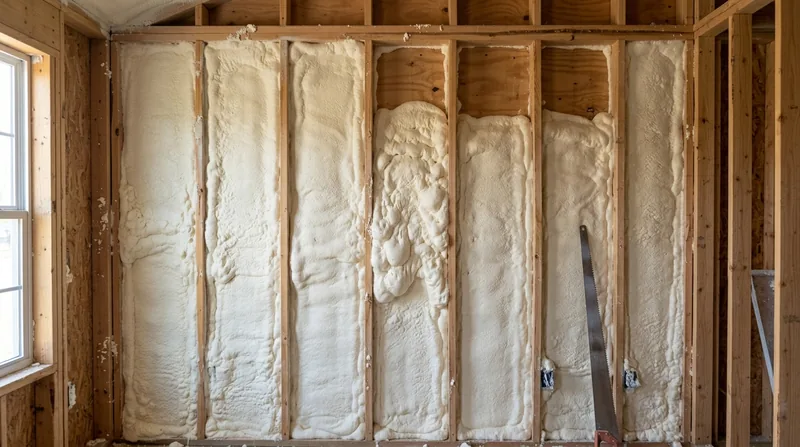




Open Cell Spray Foam Insulation in Jonesboro is the practical answer to vented attics that bake at 130-150°F through long, humid summers on Crowley's Ridge. Most homes here sit on raised foundations with brick piers and empty wall cavities, or on concrete slabs with ductwork and air handlers parked in attics that leak conditioned air constantly. Open cell foam fills those cavities, seals the thermal envelope, and keeps humidity and heat from driving your cooling costs through the roof. Unlike closed cell, open cell is permeable to moisture vapor, making it the right choice for Jonesboro's climate where humidity control matters as much as R-value. We've been installing spray foam insulation since 2012, and we know exactly what works on the homes and buildings here.
Why Open Cell Spray Foam Matters in Jonesboro's Climate
Jonesboro summers are long, humid, and relentless. Your vented attic is a thermal sieve, and fiberglass batts or blown-in cellulose settle, compress, and leave gaps where air leaks straight through to your living space. Open cell foam seals those gaps permanently, stops the air leakage, and because it's vapor-permeable, it lets moisture move through the foam rather than trapping it against your roof deck or wall sheathing. This matters on Crowley's Ridge, where humidity and crawl space moisture are the enemies of any insulation system.
- Open cell foam expands to fill all cavities and seals air leaks that batts and blown-in cannot reach.
- Vapor permeability prevents moisture accumulation inside walls and attics during humid Arkansas summers.
- Lower density than closed cell foam means lower cost per board foot while still delivering R-3.6 to R-4 per inch.
- Sound dampening properties reduce noise transmission through walls and ceilings, a bonus in rental and multi-family properties.
- Once cured, open cell meets the thermal and ignition barriers required by the building code in force at your address.
These advantages add up to a system that performs and lasts in Jonesboro's climate without the premium price tag of closed cell.
Key info: Jonesboro and surrounding areas like Brookland, Bono, and Lake City rely on vented attics and raised foundations. Open cell foam is the cost-effective choice for attics and sealed roof decks where vapor permeability and sound control matter. For crawl spaces, rim joists, and metal buildings where condensation is the driving failure, closed cell spray foam insulation is the right call.
How We Install Open Cell Spray Foam in Jonesboro Homes
Installation starts with a site walkthrough to measure your attic or wall cavities, check for existing insulation, and identify air leaks around penetrations, ductwork, and rim joists. We remove old insulation if it's failed, compressed, or contaminated, then set up mechanical ventilation to manage off-gassing during the spray and cure. We spray the foam in controlled passes, maintaining the manufacturer's drum temperature and chemical ratio, then verify thickness and R-value before we close up the space. Re-entry is safe after twenty-four to forty-eight hours, depending on ambient temperature and humidity.
- We conduct a free written estimate with R-value and thickness specifications for your exact space.
- We remove and dispose of old insulation, fiberglass batts, or failed foam before spraying new material.
- We set up mechanical ventilation during spray and cure to manage odor and off-gassing.
- We verify final thickness and density on site, documenting R-value per inch and total coverage.
- We identify and seal air leaks around ductwork, electrical penetrations, and rim joists as part of the foam installation.
The result is an insulated, air-sealed envelope that stops the thermal leakage that makes your air conditioner work overtime.
Example: A 1970s brick ranch in Jonesboro with a vented attic full of compressed fiberglass gets 4 inches of open cell foam sprayed over the roof deck, R-16 total, with all rim joists and air handler cabinet sealed. Cost runs $2,200 to $3,100 depending on attic size and access. The homeowner cuts cooling costs 20-30% and eliminates the musty smell that humidity was causing. See our attic spray foam insulation service for more examples.
Open Cell Spray Foam Installation Methods
| Approach | Description | Best for |
|---|---|---|
| Attic Deck Spray | Open cell foam sprayed 3-6 inches over the roof deck to create a sealed attic, with soffit vents closed. | Vented attics in Jonesboro homes where air conditioning efficiency is the goal. |
| Cavity Fill | Foam sprayed into wall cavities and rim joist spaces to fill voids and seal air leaks without demolition. | 1910s-1980s frame homes with empty wall cavities or older brick construction with poor insulation. |
| Retrofit Top-Up | 2-3 inches of open cell foam sprayed over existing fiberglass to boost R-value and seal air gaps. | Attics with settled or compressed batts where removal is not needed and budget is tight. |
| Garage Ceiling Spray | Open cell foam applied to the underside of garage ceilings to reduce sound and improve comfort in spaces above. | Garages in newer Jonesboro two-stories with bonus rooms, or rental properties where noise control matters. |
Open Cell Spray Foam Insulation Cost in Jonesboro: What to Expect
Open cell spray foam in Jonesboro starts at around $0.55 per board foot, which translates to $1,800 to $4,500 for a typical 1,500-2,000 square foot attic, depending on depth, access, and whether you need old insulation removed first. A smaller attic top-up with 2 inches of foam might run $1,200 to $1,800. Wall cavity fills and rim joist work are priced by the linear foot or the square footage of wall surface. The key variables are attic or wall size, existing insulation condition, access difficulty, and whether you need mechanical ventilation during cure.
Get two or three written estimates with R-value and thickness specs before you decide. Price alone is not the measure. An estimate with no thickness or R-value notation, no mention of ventilation during cure, or a promise of immediate re-entry is a red flag. We provide a free estimate within twenty-four hours. Call us at (870) 641-6546 or visit our full pricing overview for detailed breakdowns by job type.
What to Look for When Hiring a Spray Foam Insulation Contractor Near Jonesboro
The spray foam trade has two poles: the rig-and-run crews that roll through town in an out-of-state trailer, spray a job in an afternoon with no ventilation, and disappear when the smell won't go away; and the national franchises that charge premium prices and treat every job the same. A local insulation shop that knows Jonesboro's vented attics, raised crawl spaces, and humid summers is the middle ground. When you interview a contractor, ask for a written estimate that names the R-value per inch and the total thickness in inches, not just a price. Verify that they will set up mechanical ventilation during spray and cure, and that they are fully insured. Ask for references from jobs in the last twelve months, and call them. Choose a contractor who gives you a realistic re-entry window, puts the warranty terms in writing, and quotes a price per board foot in line with the local market.
- Request a written estimate that specifies R-value per inch, total thickness in inches, and the area to be insulated.
- Verify that the contractor is fully insured and ask for a certificate of insurance covering spray foam work.
- Ask whether the contractor will set up mechanical ventilation during spray and cure, and what the re-entry window is.
- Call at least two references from completed jobs in Jonesboro, Brookland, Bono, or nearby areas within the last year.
- Confirm that the contractor will remove and dispose of old insulation before spraying, and what that cost covers.
- Check with your local building department to understand whether permits or inspections are required for your address.
Once you've narrowed it down, contact us at our contact page for a free estimate with no obligation to book.
Open Cell Spray Foam Insulation in Jonesboro: Pricing Guide
| Service | Price | Details |
|---|---|---|
| Attic Deck Spray, 3-4 inches | Starting at $0.55/board ft | Typical 1,500-2,000 sq ft attic, $1,800-$2,800; cost rises with attic size, access difficulty, and old insulation removal |
| Wall Cavity Fill and Rim Joist Sealing | Starting at $0.55/board ft | Linear foot or wall square footage; 1910s-1980s frame homes with empty cavities; pricing depends on cavity depth and accessibility |
| Retrofit Top-Up, 2-3 inches over existing insulation | Starting at $0.55/board ft | Attics with settled fiberglass, $1,200-$1,800; no removal needed; cost lower because existing material stays in place |
| Garage Ceiling and Complex Multi-Area Jobs | On estimate | Site-specific variables such as vaulted ceilings, ductwork layout, and structural obstructions require on-site measurement and quote |
| Free Estimate and Consultation | Free | Written estimate with R-value and thickness specs; response within twenty-four hours; call (870) 641-6546 with no obligation to book |
Indicative pricing, the exact cost depends on square footage, finish, and site access. Free personalized estimate within 24h at (870) 641-6546.


