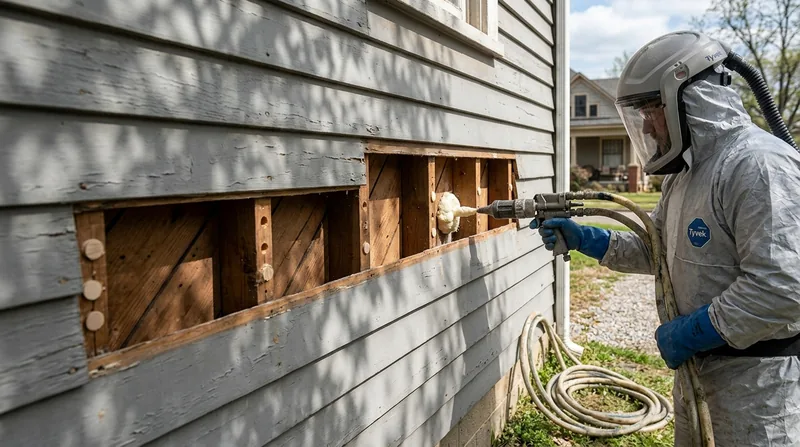




The 1910s cottages and frame homes on Jonesboro's brick piers, the 1950s-80s brick ranches with original attic insulation, and the newer two-stories spreading south toward Brookland and Bono all share one critical vulnerability: empty wall cavities that bleed conditioned air straight to the outdoors. Wall and injection foam insulation in Jonesboro seals those cavities from inside without demolition, cutting infiltration losses that pile up across a long, humid Arkansas summer. Unlike blown-in fiberglass that settles and leaves voids, spray foam and injection foam fill every corner of the wall cavity and stay put. On Crowley's Ridge where humidity and temperature swings drive energy loss year-round, that sealed envelope is the difference between a home that holds its conditioning and one that burns money fighting the Delta climate.
Why Wall and Injection Foam Insulation Matters in Jonesboro's Older Housing Stock
Jonesboro's residential foundation is built on homes that predate modern air sealing. The frame cottages and lap-sided homes around downtown Jonesboro and across Nettleton were framed with no vapor barrier and no insulation in the walls; the 1950s-80s brick ranches added fiberglass batts that have settled or shifted after sixty years; and even newer construction often leaves rim joists, band joists, and wall transitions unsealed. The result is continuous air leakage that no attic or crawl space fix alone can stop. Injection foam and closed-cell wall foam address this directly by filling the cavity completely, stopping infiltration that fiberglass cannot.
- Empty wall cavities in pre-1980 homes lose conditioned air continuously, driving cooling and heating costs higher than newer construction.
- Settled or compressed fiberglass batts leave voids that allow warm or cool air to bypass the insulation entirely.
- Injection foam fills the cavity completely without opening the wall, preserving existing siding and interior finishes.
- Sealed walls also reduce humidity infiltration, a major issue in Jonesboro's long humid summers when outdoor moisture tries to enter the home.
- Closed-cell foam provides both insulation and an air barrier, stopping infiltration in a single application.
These upgrades are the silent fix that homeowners notice immediately when their energy bills drop and their homes stop having cold spots in winter or hot zones in summer.
Key info: Arkansas building code requires that the energy code in force at your address governs wall insulation R-value and thermal barrier requirements. Jonesboro, Bono, Brookland, and other cities in Craighead County enforce the code on file at the local building department. We help you navigate what applies at your address, and we defer to the building official on all code questions. For specific requirements, contact your city building department or verify them at the permitting office before you schedule work.
How We Inject Foam Into Walls Without Demolition
Injection foam insulation lets us fill an empty wall cavity from the outside by drilling small holes through the siding, injecting low-pressure foam, and patching the holes when we are done. The process takes hours, not days, and leaves the interior untouched. We measure the wall cavity, select the foam type (open-cell or closed-cell depending on your goals), and inject at a controlled rate to fill from the bottom up without overpressure. Once cured, the foam sets hard and stays in place for the life of the home. This is how we retrofit 1920s cottages in downtown Jonesboro, brick ranches in Nettleton, and student rentals around Arkansas State without gutting walls.
- We drill small access holes through the exterior siding at intervals determined by the wall cavity depth and width.
- We insert injection lines and fill the cavity with low-pressure foam, working from the bottom up to displace air completely.
- We monitor the pressure and foam flow to ensure the cavity fills without overpressure that could bow the wall.
- We pull the injection lines, patch the holes with foam, and restore the siding finish to match the existing exterior.
- We provide a twenty-four to forty-eight hour re-entry window and keep mechanical ventilation running during the cure period.
The result is a fully insulated wall cavity with no demolition, no interior disruption, and no loss of living space. This approach is especially valuable for homes with historic or character siding that you want to preserve.
Example: A 1930s lap-sided home in downtown Jonesboro with empty wall cavities and a cold master bedroom was retrofitted with closed-cell injection foam. The cavity depth was measured, holes were drilled on 16-inch centers, and the walls were filled in one day. The homeowner kept the original siding and interior finishes intact. See our insulation replacement page for more details on retrofit projects across Greater Jonesboro.
Wall Insulation Methods and Foam Types
| Method | Description | Best For |
|---|---|---|
| Injection Foam (Low-Pressure) | Low-pressure closed-cell or open-cell foam injected through small holes, fills the cavity completely without overpressure. | Existing walls with no interior access, historic or character siding, brick ranches, cottages. |
| Open-Cell Injection Foam | Expands to R-3.6 per inch, allows vapor transmission, lighter density, lower cost than closed-cell. | Interior walls, non-critical moisture zones, sound dampening, retrofit where cost is primary concern. |
| Closed-Cell Injection Foam | Expands to R-6 to R-7 per inch, acts as air and vapor barrier, denser, stops moisture and air infiltration completely. | Exterior walls, rim joists, band joists, humid climates like Jonesboro where moisture control is critical. |
| Spray Foam in Open Walls | Sprayed directly into an open wall cavity during new construction or renovation, fills and seals in one pass. | New construction, gut renovations, additions, any job where walls are open and accessible. |
The choice between open-cell and closed-cell injection foam depends on the wall location, the climate exposure, and your budget. Exterior walls in Jonesboro's humid environment almost always call for closed-cell foam because it stops both air and moisture infiltration. Interior walls can often use open-cell foam at a lower cost. We specify the foam type based on the wall and your goals, and we document the R-value and thickness in every estimate.
Wall and Injection Foam Insulation Cost in Jonesboro: What to Expect
Wall and injection foam insulation costs in Jonesboro typically start at $2 to $4 per square foot of wall cavity, depending on the foam type, the cavity depth, the number of stories, and the complexity of the wall layout. Closed-cell foam costs more than open-cell because it provides higher R-value and acts as an air and vapor barrier. A single-story exterior wall retrofit on a modest 1950s ranch costs less than a two-story retrofit on a larger home with multiple wall sections and transitions. Access also matters: a home with easy exterior access and simple siding costs less than one with complex architectural details or tight site conditions.
- Closed-cell injection foam, which provides R-6 to R-7 per inch and stops moisture, typically costs more than open-cell but is the standard for exterior walls in humid climates like Jonesboro.
- Open-cell injection foam, which provides R-3.6 per inch and costs less, is a good fit for interior walls or homes where budget is the primary driver.
- Wall cavity depth, number of stories, and the presence of obstacles like electrical outlets or plumbing affect both the labor time and the foam volume required.
- Homes with multiple wall sections, dormers, or complex exterior geometry cost more because each section requires separate access holes and careful injection sequencing.
- Getting two or three written estimates with R-value and thickness specifications lets you compare apples to apples and spot any estimate that lacks technical detail.
We provide every estimate in writing with the R-value, foam thickness, cavity depth, and square footage clearly stated. This lets you verify the scope and compare our quote to others with confidence. For a detailed pricing overview and to discuss your home's specific needs, visit our pricing page or call us at (870) 641-6546 for a free estimate.
What to Look for When Hiring a Wall and Injection Foam Contractor Near Jonesboro
Finding the right spray foam and injection foam contractor is as important as the work itself. The spray foam trade includes both rigorous local shops that stand behind their installations and rig-and-run crews that disappear when a problem emerges. Before you hire, verify that the contractor is fully insured, ask for references from recent local jobs, and request a written estimate that includes R-value, foam thickness, and cavity specifications. Check that they understand local building code requirements at your address and can explain how permits and inspections apply to your home. Ask about their re-entry protocol, mechanical ventilation during cure, and the timeline for safe occupancy after the work is done.
- Confirm that the contractor is fully insured and ask to see a certificate of insurance naming your address as an additional insured.
- Request a written estimate with R-value, foam thickness, cavity depth, and square footage so you can compare multiple quotes accurately.
- Ask for references from three recent jobs in Jonesboro, Bono, Brookland, or nearby towns and call them to ask about the work quality and the contractor's responsiveness.
- Verify that the contractor understands local building code and permitting at your address, and can explain what applies to your home.
- Confirm the re-entry protocol, including mechanical ventilation during cure and the estimated timeline before the home is safe for full occupancy.
- Avoid any estimate with no R-value or thickness specified, any quote that promises immediate re-entry, or any contractor whose insurance cannot be verified.
The strongest signal of a competent contractor is a detailed estimate, a clear explanation of the foam type and why it is right for your wall, and a willingness to answer your questions without rushing you. If you are ready to get started, contact us for a free estimate or call (870) 641-6546. We will schedule a site visit, measure your walls, and provide a written quote with all the technical details you need to make an informed decision.
Wall & Injection Foam Insulation in Jonesboro: Pricing Guide
| Service | Price | Details |
|---|---|---|
| Open-Cell Injection Foam | Starting at $2/sq ft | Lower R-value per inch, good for interior walls and budget-conscious retrofits in Jonesboro homes |
| Closed-Cell Injection Foam | Starting at $3.50/sq ft | Higher R-value and moisture barrier, standard for exterior walls in humid Jonesboro climate conditions |
| Multi-Story or Complex Wall Retrofit | Starting at $4/sq ft | Two-story homes, multiple wall sections, dormers, or tight site access increase labor and material costs |
| Spray Foam in Open Walls | On estimate | New construction or gut renovation requires site assessment to confirm cavity dimensions and foam volume needed |
| Travel and Site Visit | Included | No separate mileage or travel fee for Jonesboro, Bono, Brookland, Lake City, Caraway, Monette, and surrounding areas |
| Free Estimate | No obligation | Written quote with R-value and thickness specs, response within 24 hours at (870) 641-6546 |
Indicative pricing, the exact cost depends on square footage, finish, and site access. Free personalized estimate within 24h at (870) 641-6546.


