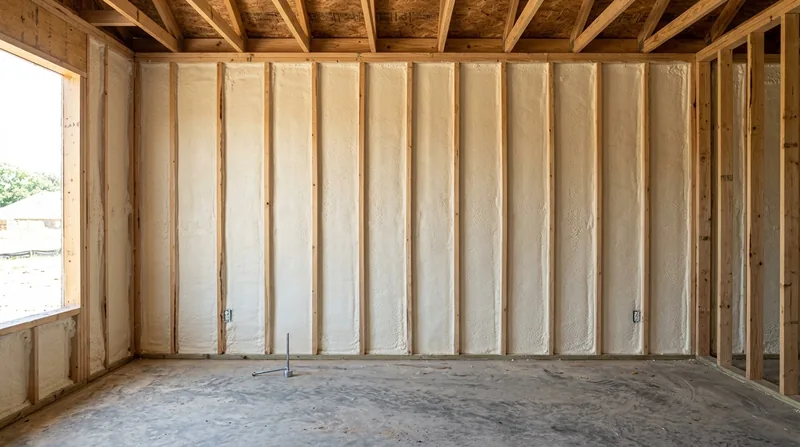




Jonesboro sits on Crowley's Ridge, where homes perch on vented crawl spaces and attics that bake at 130 to 150 degrees through long humid summers. The landscape rolls from downtown's 1910s frame cottages on brick piers to the 1950s brick ranches with flattened original insulation, and out to the newer two-stories spreading south toward Valley View and Brookland. That humidity and the thermal load of a vented attic create the conditions where closed cell spray foam insulation stops being optional and becomes the engineering answer. Closed cell foam seals air leaks, resists moisture infiltration, and holds its R-value in the presence of humidity that would flatten fiberglass batts. If your attic or crawl space sits in that humid Jonesboro climate, closed cell foam controls both temperature and moisture in one pass. We apply closed cell foam to attics, sealed roof decks, crawl spaces, rim and band joists, garage ceilings, metal buildings, and retrofit wall cavities across Jonesboro, Bono, Brookland, and the surrounding Delta.
Why Closed Cell Spray Foam Matters in Jonesboro's Humid Climate
Jonesboro's summers are long, humid, and relentless. The combination of outdoor moisture, vented attics that draw in warm air, and crawl spaces that sit just inches above soil creates an environment where standard fiberglass or cellulose insulation degrades over time. Closed cell foam does not absorb moisture, does not compress under humid conditions, and maintains its air-sealing properties for decades. The Ridge's oak, hickory, and sweetgum forests release moisture into the air; the rice and soybean fields to the south pump humidity across the county; and homes on brick piers or slabs with vented crawl spaces are exposed to that moisture from below. Closed cell foam stops that infiltration at the source.
- Closed cell foam resists moisture absorption and does not degrade in humid conditions like fiberglass does.
- The air-sealing properties of closed cell foam reduce the load on your air conditioning system during Jonesboro's hot, humid summers.
- Sealed attics and crawl spaces prevent warm, moist outside air from entering during the day and cool, conditioned air from leaking out at night.
- Closed cell foam's R-value of 6.0 to 7.0 per inch makes it the right choice when space is tight, such as in rim joists or shallow roof cavities.
In Jonesboro's climate, the difference between a vented attic and a sealed one is the difference between fighting humidity all summer and controlling it.
Key info: A 1950s brick ranch in Jonesboro with a flattened attic full of original fiberglass sits at R-19 and loses R-value every summer as humidity compresses the batts. Closed cell foam at 5.5 inches in that same attic delivers R-33 and stays there, resisting the moisture that would flatten any fibrous insulation.
For more on how sealed attics compare to vented ones, see our page on attic spray foam insulation in Jonesboro.
How We Install Closed Cell Spray Foam in Jonesboro
Closed cell foam installation is a precise process. The foam is mixed at exact ratios, sprayed at the right temperature, and applied in controlled passes so it expands evenly and bonds to the substrate. The space must be properly ventilated during application and curing, and the area must be clear of occupants for 24 to 48 hours after spraying. Once cured, the foam is trimmed flush to the framing, and any required thermal or ignition barriers are installed per your local building code. The job is done when the space is re-entry ready and your HVAC system can operate in a sealed, conditioned envelope.
- We inspect the substrate for moisture, leaks, or contamination and address any issues before spraying.
- The foam is sprayed in uniform passes to achieve the specified R-value and thickness without voids or thin spots.
- Mechanical ventilation runs during application and the specified cure time to manage isocyanate vapors.
- Once cured, foam is trimmed and any thermal barriers required by code are installed and sealed.
- We verify that all air sealing is complete and that the space meets code before final walkthrough.
The result is a sealed, insulated space that stops air leakage and moisture infiltration in one application.
Example: A crawl space in Lake City with brick piers and no vapor barrier sits at 85 percent humidity in summer. We spray 2 inches of closed cell foam on the rim joists and band joists, seal the band box, and the humidity drops because the foam stops outside air infiltration. The space stays dry, the wood framing stays sound, and termite inspectors can still see the foundation.
Learn more about our approach to crawl space spray foam insulation in Jonesboro.
| Approach | Description | Best for |
|---|---|---|
| Attic and sealed roof deck | Closed cell foam applied to the underside of the roof deck or to the attic floor, creating a sealed, conditioned space. | Homes with vented attics that leak conditioned air and allow hot, humid outside air to enter. |
| Rim and band joist | Closed cell foam applied to the rim joist, band joist, and band box to seal the thermal envelope where the foundation meets the framing. | Crawl spaces and basements where air leakage and moisture infiltration are the primary energy loss. |
| Crawl space | Closed cell foam sprayed on rim joists, band joists, and band box; sometimes on the underside of the floor system. | Homes on piers or over crawl spaces where humidity and moisture are the controlling failure mode. |
| Retrofit wall insulation | Closed cell foam injected into existing wall cavities through small holes, filling empty cavities without removing siding or interior drywall. | Pre-1980 frame homes in downtown Jonesboro and Nettleton with empty walls and original lap siding. |
| Metal building and garage | Closed cell foam applied to the underside of the roof deck or to wall panels to control condensation and maintain temperature. | Farm equipment sheds, grain yards, and garages where condensation drips from steel and metal is the dominant material. |
Closed Cell Spray Foam Insulation Cost in Jonesboro: What to Expect
Closed cell spray foam starts at approximately $1.20 per board foot, with most Jonesboro jobs ranging from $1.20 to $1.60 per board foot depending on the scope, access, and substrate condition. A typical attic or sealed roof deck in a Jonesboro home runs 3,000 to 5,000 board feet and falls between $3,600 and $8,000. A crawl space rim and band joist job is smaller, usually 500 to 1,500 board feet, and runs $600 to $2,400. Wall injection foam retrofit in an older Jonesboro home may be 200 to 800 board feet and cost $240 to $1,280. The factors that move the price are the size of the space, the height and difficulty of access, whether the substrate is clean and dry, and the distance from our shop in Jonesboro.
Getting two or three written estimates with R-value and thickness specifications is the smart way to compare. Each estimate should spell out the board feet, the inches of foam, the R-value you will receive, and any air sealing or thermal barrier work included. Avoid any estimate that quotes a price per square foot or that does not specify thickness and R-value. For detailed pricing and to request a free estimate, visit our pricing page or call us at (870) 641-6546.
What to Look for When Hiring a Spray Foam Contractor Near Me in Jonesboro
Jonesboro and the surrounding Delta have local spray foam shops, national franchise operations, and out-of-state rig-and-run crews. The difference between them matters. A local contractor with a local address and local plates is reachable after the job. A national franchise carries overhead that inflates the price. An out-of-state crew sprays the job in an afternoon, collects the money, and disappears when the smell will not go away or when the foam does not cure properly. Here is what to verify before you sign a contract.
- Verify that the contractor is fully insured and ask for a certificate of insurance naming you as additional insured during the work.
- Request written estimates from at least two contractors that specify R-value, thickness in inches, board feet, and the cost of any air sealing or thermal barriers.
- Check references from recent jobs in Jonesboro, Bono, Brookland, or nearby towns and ask about the contractor's response if issues arose after the work.
- Confirm that the contractor understands the local building code and any permits required at your address in Jonesboro or your city.
- Ask whether the contractor uses a third-party inspector or quality-assurance process to verify the foam is applied correctly.
- Avoid any estimate that quotes a price per square foot without specifying thickness, or that promises immediate re-entry without a stated cure time.
The honest contractor will walk away from a wet substrate, will not spray over a leaking roof, and will give you a written warranty on the workmanship. Those are the signs of a shop that will still be reachable in six months if you have a question. For a free estimate and a conversation with a local Jonesboro spray foam contractor, contact us today.
Closed Cell Spray Foam Insulation in Jonesboro: Pricing Guide
| Service | Price | Details |
|---|---|---|
| Attic or sealed roof deck | Starting at $1.20/board ft | Typical 3,000 to 5,000 board feet; cost increases with roof pitch, access difficulty, and substrate prep required |
| Crawl space rim and band joist | Starting at $1.20/board ft | Usually 500 to 1,500 board feet; larger spaces or poor access may increase per-board-foot cost slightly |
| Wall injection foam retrofit | Starting at $1.20/board ft | Pre-1980 frame homes in downtown Jonesboro; 200 to 800 board feet per wall; includes drilling and patching |
| Metal building or garage | Starting at $1.20/board ft | Farm sheds and equipment buildings; condensation control on steel requires closed cell; scope varies widely by building size |
| Travel and mobilization | Included | No separate charge for jobs in Jonesboro and surrounding service areas within 20 miles of our location |
| Free written estimate | Free | Response within 24 hours; includes R-value, thickness, board feet, and any air sealing or barrier work required by code |
Indicative pricing, the exact cost depends on square footage, finish, and site access. Free personalized estimate within 24h at (870) 641-6546.


